
Showing Up When It’s Hard
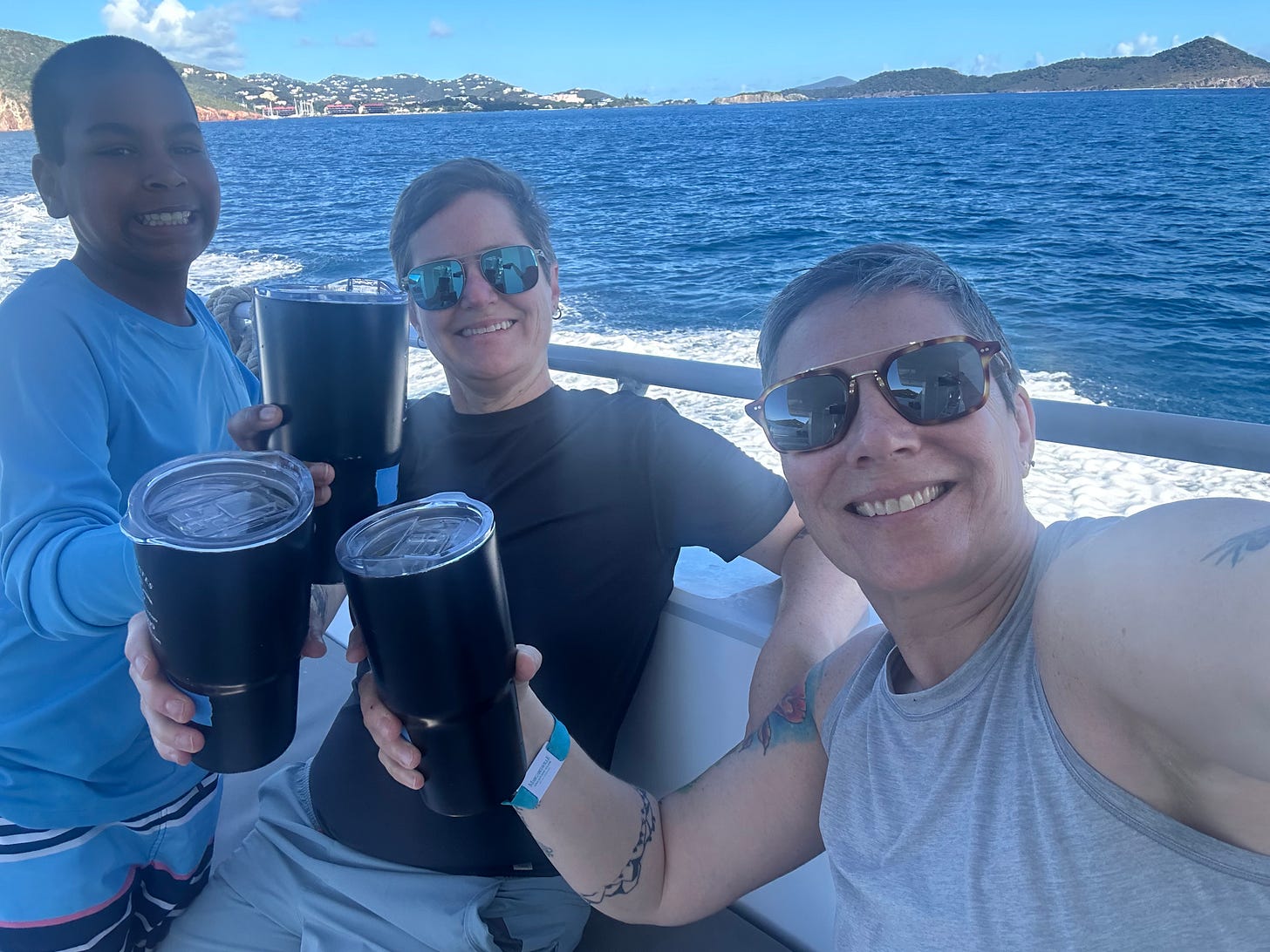
Vacations are full of magic—swimming with turtles, pizza delivered to a boat, a swim-up taco bar (hello, heaven). But there’s a part of vacation that can make or break everything—the moment when everyone is overstimulated, exhausted, hungry, and no one is at their best.
Yesterday, for us, that moment hit in the grocery store.
Leo and I found ourselves locked in a cereal aisle standoff. And if you’ve ever traveled with kids, you know—it’s never really about the cereal.
For me, it wasn’t just about what ended up in the cart. It was about something deeper: the old feeling of being a middle child, the need to hold space for myself with a death grip. It was about an invisible part of me whispering, You don’t matter unless you fight for it.
For Leo, it was something else. Maybe the need to have autonomy, to be heard, to feel like their preferences carried just as much weight. Two protector parts colliding over breakfast food.
And here’s the thing: when we are tired, overstimulated, and under-resourced, our protector parts take the wheel. These are the parts of us that learned, as kids, what we had to do to feel safe, seen, and heard. They show up in the form of control, people-pleasing, shutting down, over-explaining, or digging in our heels.
And in moments like these, we have a choice:
-
Do we react from that unhealed place?
-
Or do we slow down, take a breath, and meet the moment differently?
I know, I know. Breathe? In the middle of a standoff? Sounds basic and cliché. But in reality, this is the work.
There is power in extending the space between stimulus and response. Too often, we react immediately—without intention, without thought. We let our unhealed parts drive. This is when we say the thing we regret, when we snap, when we double down out of pride or frustration.
Even just three seconds of space can shift the whole interaction.
-
Take a deep inhale for 4 seconds, hold for 4 seconds, exhale for 4 seconds, hold again for 4 seconds (box breathing).
-
If needed, physically step away: I’m going to grab some fruit, I’ll be right back.
-
Offer a tiny pause before responding: Let me think about that for a second.
Slowing down helps disengage our nervous system from fight-or-flight mode. And that tiny gap is often all it takes to choose a different path.
When we feel triggered, it’s rarely about the situation itself. It’s about what it represents.
For me, it wasn’t just about cereal. It was about an old wound—feeling invisible, like what I want doesn’t matter. I had to recognize:
-
This isn’t about Leo disrespecting me.
-
This is about my inner child feeling unseen.
-
And I have the power to meet that part of me with love, rather than letting it take over.
When we can name what’s really happening, we take back control from our past. Instead of reacting from old wounds, we can respond with awareness and intention.
Our loved ones can’t read our minds. Clarity is kindness. Instead of expecting Leo (or anyone) to just know what I need, I can use my words.
Instead of shutting down, powering through, or going into control mode, I can simply say:
💬 It feels yucky to me to pick a cereal I don’t like at all. Can we meet in the middle?
That’s it. That’s the shift. No power struggle, no demand—just clarity, directness, and an invitation for compromise.
Leo wasn’t trying to make me feel invisible. They weren’t intentionally disregarding me. They were simply trying to advocate for their own choice—just like I was.
When kids push back, it’s not an attack—it’s an attempt to be seen.
When I remember that, it changes how I show up. Instead of making it about me, I can recognize that Leo is learning, just like I am.
Here’s the part that matters most: when I tell Leo, I love that you want to try Captain Crunch—let’s make sure we do another time, I actually need to make that happen.
Because this is how we build trust—not just in the moment, but in the long run.
If I say we’ll try it next time, and then I follow through, Leo learns:
✔️ My voice matters.
✔️ I don’t have to fight to be heard.
✔️ My parent is someone who keeps their word.
And when I model this, I also teach them how to do the same for others.
The truth is, we are practicing something much bigger than choosing a cereal. We are practicing how to be humans who can:
✔️ Stand for themselves and make space for others.
✔️ Navigate conflict with kindness and respect.
✔️ Show up for each other, even when we’re tired, hungry, and overstimulated.
And I can’t think of a better thing for an 11-year-old (or a nearly 50-year-old) to keep practicing.
✨ This is the work. And I think it’s how we move the needle—not just in our families, but in our relationships, our communities, and the way we show up in the world.

