
My Marriage Ended in a Whisper
It didn’t start with a big moment.
It started with a whisper.
Or maybe before that.
If I’m honest, I knew before it even began.
I’ll call him Eric. I met him just out of college. He asked me out, and I said no. But he kept orbiting. And as the years went on and the pressure to “be happy” mounted, I began to wonder:
Is this it? Is he the one?
I wanted love.
I wanted home.
I wanted to be chosen, to have Valentine’s Days and anniversaries and someone to hold my hand in public. I wanted to not feel so fucking alone. And that desire got louder and louder — so loud I couldn’t hear myself anymore.
He was kind. He was cute. It could work, right?
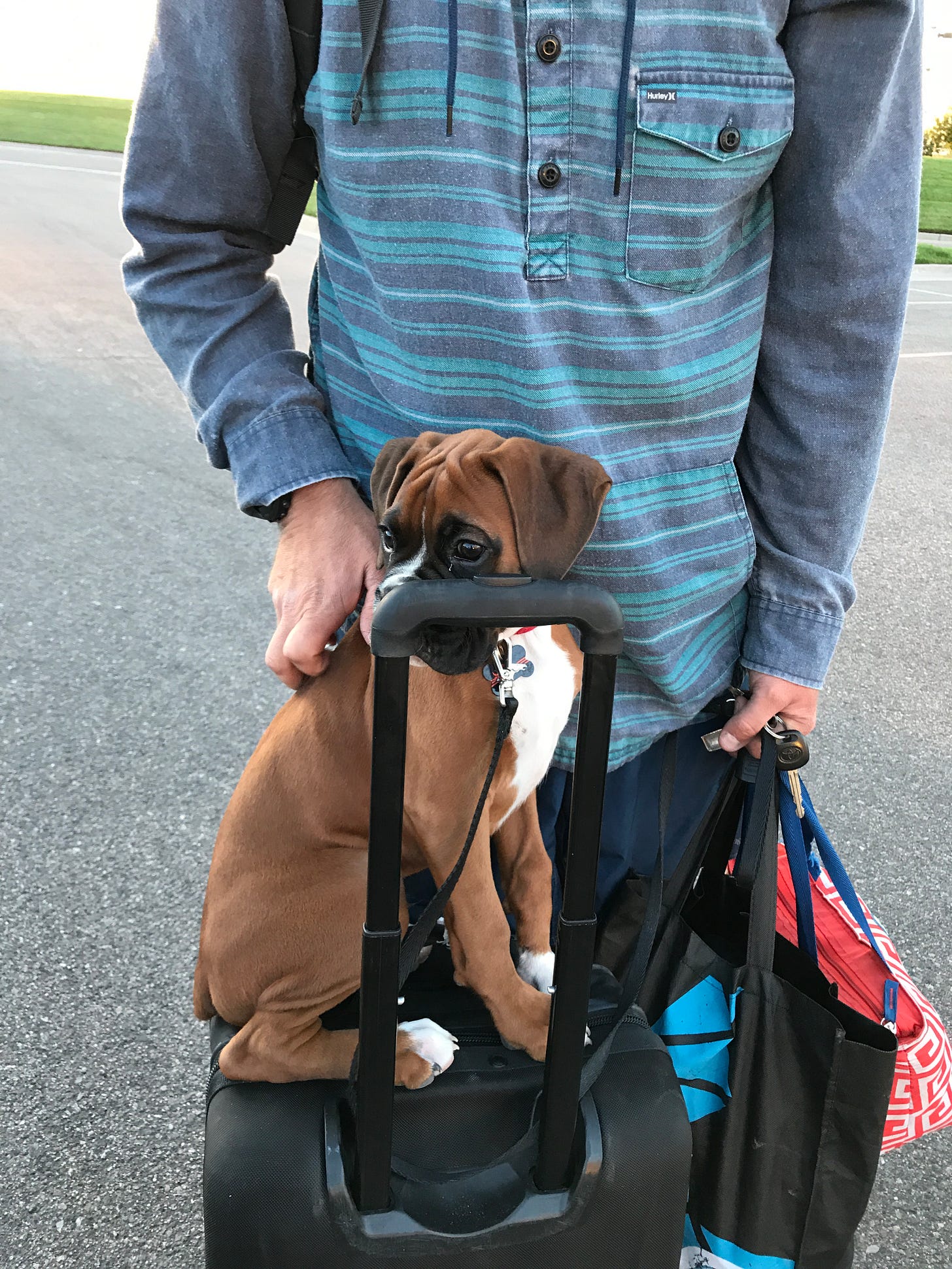
Even after our first date — when he left me and my puppy Otis waiting in a hotel lobby all day — I stayed. I didn’t want to bother anyone. I didn’t want to admit I’d gotten myself into something that already didn’t feel right.
But here’s the truth:
I wasn’t willing to subject my puppy to walking home, but I was willing to do that to myself.
There were whispers all along the way.
They came when he made work stops on our rare time together and left me waiting in the car.
They came when I dreaded his phone calls.
When he didn’t show up for my family.
When he made my dreams — like going for a doctorate — feel selfish.
When I spoke of purpose, or faith, or the future, and he changed the subject.
The whispers were everywhere. Like a steady wind.
And I didn’t ask what they were trying to say.
I just braced harder.
I didn’t want to fail.
Didn’t want to ruin this “opportunity.”
Didn’t want to be the problem.
So I tried to muscle through.
More prayer. More mantras. More breathing. More love-your-enemies theology.
More effort to “get my mind right.”
But it wasn’t my mind.
It was my body.
It was my soul.
It was my fucking knowing.
Part of what kept me stuck was my faith.
Not because of God — but because of how I’d internalized love your enemies to mean:
stay, be agreeable, don’t disappoint, don’t make waves.
I thought it was more righteous to love him when it was hard, when I felt small.
I thought being the “bigger person” meant absorbing the loneliness, the resentment, the dread — and loving through it.
But that wasn’t love.
That was spiritual bypass.
I was dosing discomfort with positivity.
Drowning red flags in mantras and beach selfies.
Telling myself, this is what unconditional love looks like.
But it wasn’t love. It was conformity.
It was me abandoning myself in the name of virtue.
Love isn’t about agreement.
Love isn’t about shrinking to keep the peace.
Love isn’t about losing your voice to keep someone company.
Real love starts with self-honoring.
With boundaries. With truth.
With being messy and honest and in it — not around it.
And none of it was real.
Not the smiles.
Not the story.
We weren’t happy.
I wasn’t home.
We were living separately at the time — me in Eagle at the church parsonage, him back at our house. I’d visit when I could, and each time I dreaded it. I’d spend the whole 90-minute drive trying to find peace, trying to force gratitude, trying to silence the screams inside me.
And it just got harder and harder.
The last trip, I tried everything — music, prayer, mantras — and nothing worked.
The closer I got, the more caged I felt. The angrier. The more exhausted.
When I arrived, he was injured — laid out on the couch with back pain. And I had nothing left to give. He needed tenderness. I felt fury. I hated who I was becoming.
Earlier that day, I saw a bat that had been run over on the bike path. Still alive. Screeching. Its little teeth stuck in my mind. I felt such compassion for that bat. Such pain.
And then I realized: that was me.
Screeching. Wounded. Still alive.
And no one was coming.
We fought. Big and loud and messy.
And this time, I didn’t stay.
I loaded Otis in the car.
I made the call — to myself.
I drove home.
It took two years to make that drive.
But when I finally did, I felt relief. Deep, bottom-of-my-lungs relief. Not heartbreak. Not fear.
Relief.
My marriage was over.
And for the first time in a long time,
I wasn’t fighting the wind. I was sailing.
And this isn’t to say Eric did anything wrong.
He was himself.
But I wasn’t listening to myself — and that created an energy. A misalignment.
And that energy turned into rage.
I became someone I hardly recognized. Explosive. Bitter.
The kind of person I never wanted to be.
That’s what happens when we ignore our truth for too long.
But I came home.
And I’m still here.
“Love your enemy” isn’t about staying quiet.
It isn’t about being agreeable.
It isn’t about absorbing hurt to keep things “holy.”
It’s about loving the parts of yourself you’re at war with.
Loving the parts that want to run.
Loving the parts that judge, rage, explode.
Loving the parts that want to disappear just to make others comfortable.
Love the acne.
Love the extra pounds.
Love the part that needs more rest.
Love the version of you who stayed too long.
Love the one who finally got in the car and drove home.
Love is truth. Love is honoring. Love is boundaries.
Love is walking through pain — not away from it.
At first, I was disgusted by the bat.
Mad that it made me feel something.
Bats are so gross, right? So dirty. So invasive.
And then I saw its tiny teeth.
That detail undid me.
The way it cried out. The way it still fought to live.
I saw myself.
And I wanted to end its pain.
But if I’m honest?
I wanted to kill the bat so I wouldn’t have to feel its pain.
I wanted to erase the discomfort, fix the problem, take control.
Not out of mercy — but out of fear.
Because its pain touched my pain.
And then I realized — it’s not mine to know.
Not mine to fix.
Not mine to control.
Maybe the bat is working out its own curriculum.
Maybe all I’m called to do is bear witness and offer love.
That is what “love your enemy” means to me now:
To love something not because it’s clean or easy —
but because it’s alive.
To sit in the discomfort.
To walk beside pain.
Not to fix it.
Not to extinguish it.
Not to overtake it.
But to say: I see you. I will not turn away.
That’s what I couldn’t do in my marriage.
That’s what I finally learned to do for myself.
I walked away from a marriage.
But more importantly, I walked toward myself.
It took two years to make that drive.
But when I did, I wasn’t fleeing.
I was returning.
To truth.
To peace.
To a body that no longer screamed.
To the quiet hum of knowing.
To Otis.
To the woman who heard the whisper.
To the woman who stayed.
To the woman who finally left.
This is what it means to love your enemy.
To hold the pain without needing to erase it.
To see the bat — not as a problem to solve — but a soul to honor.
To love yourself enough
to let others walk their own path
and to keep walking yours.
If you feel called, I’d be honored to have you as a paid subscriber.
Your support helps me keep writing, creating, and sharing the real, raw, soulful stuff — the heartbreak, the healing, the holy mess. It supports my work, my words, and yes, my ministry (the kind that happens in bat poems and whispered truths).
As a bonus, you’ll get access to all the goodies — the poems, the practices, the audio soul-hugs, and whatever else I dream up that makes this space more nourishing and alive.
To my paid subscribers:
I am beyond grateful.
You touch my heart. You make this possible.
Honestly, you’re the weird little lanterns lighting the way through the fog, and I love you for it.
Whether you’re paid or free, thank you for reading, for listening, for being in this conversation with me. It means the world.
Let’s keep walking each other home.
Mess and all.
— Molly 💫


