
Not Until the Third Marriage Did I Understand the Word ‘Wife’
Reclaiming language, identity, and the sacred self through partnership and presence.
Before I ever said the word “wife” out loud — it lived in my body like a contradiction.
Wife meant “less than.”
The one with the chores. The one who serves. The one who stays behind.
Wife meant lipstick, high heels, silence, duty.
And still — somehow — wife also meant “you made it.”
The prize. The proof. The role that says, “Someone chose me.”
So I held both: ultimate belonging and second-class citizenship.
To be a wife was to be special — but never quite equal.
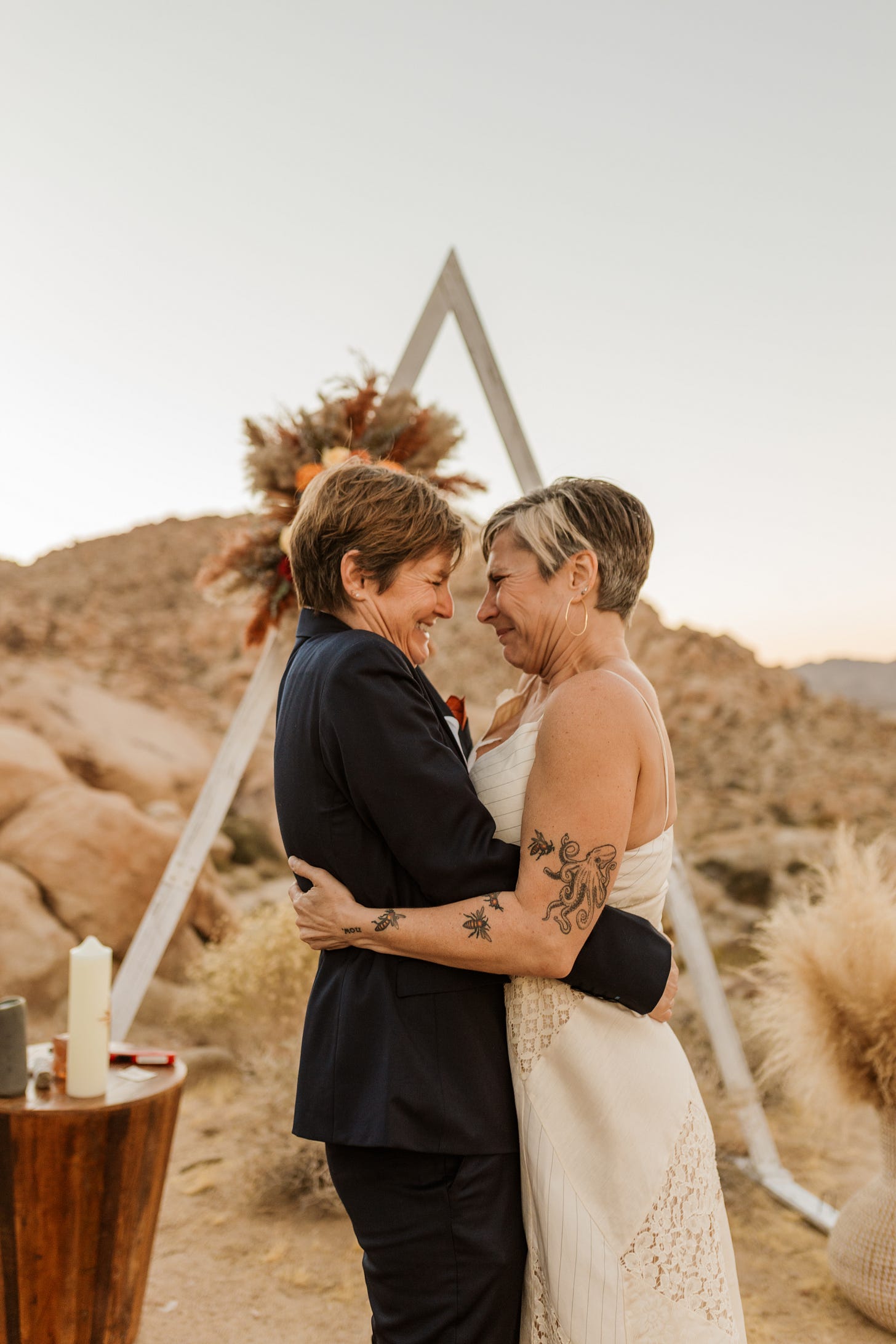
We said our vows in Joshua Tree under a setting sun, with a handful of witnesses and my spiritual coach officiating.
It was my third marriage.
But it was the first time it didn’t feel like a performance.
The first two?
They were ego-marriages.
I said “I do” for safety, status, and proof of worth.
This time?
I said “I do” to soul partnership.
It wasn’t about being chosen.
It was about choosing.
Not proving.
Presence.
She was not claiming me.
She was meeting me.
And for the first time, wife didn’t mean sacrifice.
It meant sacred.
For so long, I thought belonging was something others gave me.
A ring. A vow. A role. A title.
But it never worked.
I got married and felt lonelier.
I traveled to paradise and felt more lost.
I got what I thought I wanted and felt further from myself than ever.
I thought marriage would end the ache.
Instead, it named it.
Turns out, I was missing.
After my second divorce, I quit the performance.
I got off the treadmill of trying to earn love.
I stopped chasing belonging by being better, thinner, smarter, quieter.
I got curious about my own company.
I let women into my inner circle.
I softened. I listened. I began to love my own femininity — the very thing I’d once pushed away as “less than.”
And then… she showed up.
My wife.
My person.
The one who loved the parts of me I hadn’t yet learned to hold.
The one who didn’t ask me to shrink, but to become.
I used to think wife meant second.
Second to a husband.
Second in power.
Second to a life about someone else’s story.
But being a wife to a wife changed everything.
It became my revolution.
Because when I stood in the desert, barefoot in Joshua Tree, looking into her eyes —
I didn’t feel like a supporting character.
I felt like a mirror.
Whole.
Worthy.
Equal.
Loved not for what I gave, but for who I am.
We both said “I do” — not to a contract, not to a performance — but to a journey.
We said yes to walking with each other, not behind.
Yes to lifting each other, not carrying or being carried.
Yes to staying true to ourselves and one another.
This is what “wife” always should have meant.
🔍 Wife comes from Old English wīf, meaning “woman.”
Not property. Not second-class. Not supporting cast.
Just a woman in her fullness.
It wasn’t until centuries later that “wife” became tied to subservience, to domesticity, to being owned.
But originally?
A wife was a midwife, a fishwife, an alewife —
A woman of skill. A community force.
So what I’m doing now —
Is not redefining wife.
I’m remembering her.
I’d say:
Oh sweetie, you are what you seek.
You are the love, the acceptance, the worth.
You are the prize.
You don’t have to earn it.
You don’t have to be chosen to matter.
You were always whole.
It’s not about a ring.
It’s not about a man.
It’s not even about the word.
It’s about coming home.
Thank you for supporting my work as a paid subscriber.
These extras are my way of saying thank you — and of deepening the conversation. I hope something here meets you where you are.
Let’s reclaim our language. Let’s come home to ourselves.


